---
title: How Record-Preserving Merges Work in Koalify
description: Learn how Koalify’s Hybrid (Synthetic) Merge works in HubSpot. Merge companies without creating a new record, preserve HubSpot record IDs, and avoid merge history limits.
---
[Skip to content](https://koalify.io/knowledge-base/how-hybrid-synthetic-merges-work-in-koalify#main-content)
![koalify\_rectangle\_-3.png\]](https://koalify.io/hs-fs/hubfs/koalify_rectangle_-3.png?width=50&height=50&name=koalify_rectangle_-3.png)
Open main navigation
Close main navigation
- [GET STARTED FREE](https://api.koalify.io/hubspot/install?utm_source=koalify&utm_medium=knowledgebase&utm_campaign=navigation)
[GET STARTED FREE](https://api.koalify.io/hubspot/install?utm_source=koalify&utm_medium=knowledgebase&utm_campaign=navigation)
Search the Deduplication Knowledge Base 🐨
- There are no suggestions because the search field is empty.
1. [Koalify Knowledge Base](https://koalify.io/knowledge-base?hsLang=en)
2. [Koalify settings](https://koalify.io/knowledge-base/koalify-settings?hsLang=en)
# How Record-Preserving Merges Work in Koalify
## Koalify makes it possible to merge company records even in situations where HubSpot’s native merge process may not be suitable, such as when certain integrations are active or when stable record IDs are required.
By default, HubSpot’s native merge process creates a **new primary record** when records are merged. While this behavior works well for most use cases, but it can create problems when **integrations depend on existing HubSpot record IDs** or when **merge history limits** are reached.
Koalify offers an alternative merge mode called **Record-Preserving Merge**. You may also see this referred to as a Hybrid Merge or Synthetic Merge. This mode is designed to closely replicate the outcome of a native HubSpot merge while avoiding some of its platform limitations.
### What happens during a Record-Preserving Merge?
During a Record-Preserving Merge:
- The **secondary record is deleted**
- The **existing primary record is updated** with combined data
- No new record is created
Important data such as **property values, activities, and associations is preserved** and consolidated on the existing primary company record.
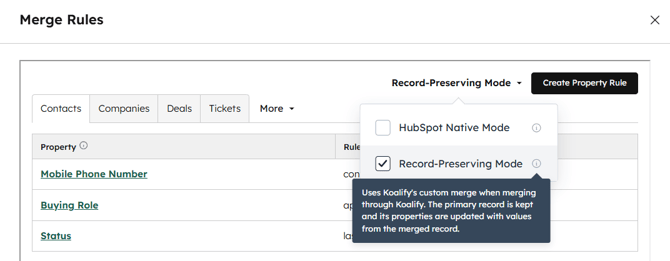
### Why use a Record-Preserving in HubSpot?
#### **1) Salesforce integration**
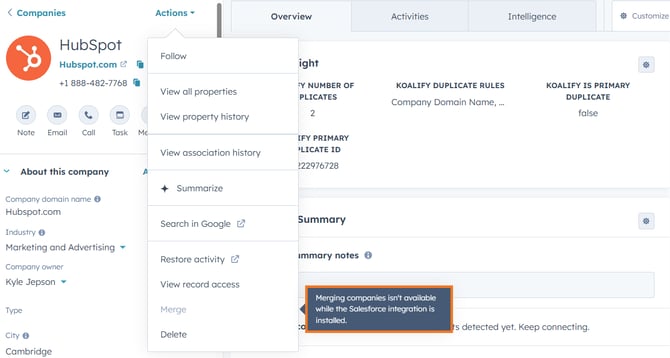
Historically, HubSpot has not supported company merges when the Salesforce integration is active, including through the API.
A Record-Preserving Merge provides an alternative way to consolidate records without relying on HubSpot’s native merge process.
#### **2) Preserve HubSpot Record IDs** HubSpot’s native merge creates a new record, which means the merged record gets a new HubSpot record ID. That can cause issues for integrations, sync logic, or internal processes that rely on stable HubSpot record IDs. A Record-Preserving Merge keeps the existing primary record in place, so its record ID does not change.
#### **3. Avoid HubSpot’s merge ID storage limit**
HubSpot stores merged record IDs on the primary record but limits this to **250 stored merge IDs**. In portals with high deduplication volume, this limit can be reached.
A Record-Preserving Merge avoids this limitation because no new merged record is created and no merge ID history needs to be stored in the same way.
### How Koalify’s Record-Preserving Merge works
Koalify’s Record-Preserving Merge is designed to behave similarly to HubSpot’s native merge, with a few important differences.
#### **General behavior**
- **No new record record** is created
- The **secondary record is deleted**
- The primary record is updated with selected data from the secondary record
#### **Standard properties**
- The secondary record’s `email` and `hs_additional_emails` values are appended to the primary record’s `hs_additional_emails`
- The secondary record’s `domain` and `hs_additional_domains` values are appended to the primary record’s `hs_additional_domains`
- Lifecycle stage is advanced to the furthest stage reached across the two records for contacts and companies
- If the primary record already has a value → it remains unchanged
- If the primary record is empty and the secondary has a value → the secondary value is used
You can also customize property behavior with [Koalify merge rules](https://koalify.io/knowledge-base/how-to-create-custom-merge-rules-in-hubspot-with-koalify?hsLang=en)
#### **Read-only properties**
Properties that cannot be written via the API are not updated, including:
- Analytics properties
- Calculated fields
- System-generated properties
#### **Activities (calls, emails, tasks, meetings)**
- All activities from both records are combined under the primary company
#### **Associations (contacts, companies, deals, tickets, etc.)**
- Associations are merged unless this would exceed HubSpot’s association limits
- If the limit is exceeded, the merge won’t succeed, you’ll need to reduce associations first
#### **Associated leads**
- Due to HubSpot API limitations, only leads linked to the **primary contact/company** are retained
- Leads associated with the secondary contact/company will not be preserved
#### **Segments**
- Only the primary records' static segment memberships are retained on the surviving record.
- Active segment memberships are re-evaluated based on the merged record's current properties. If the merged record meets the segment criteria, it stays. If not, it falls out.
#### **Workflows**
- The primary company may be enrolled if updated data matches workflow criteria
- The secondary company is automatically unenrolled when it is deleted
Merging is irreversible, so we recommend testing a couple Record-Preserving merges manually with [our duplicate cards feature](https://koalify.io/knowledge-base/how-to-merge-hubspot-duplicates-using-the-koalify-duplicate-cards?hsLang=en) before [bulk merging via the Koalify workflow action.](https://koalify.io/knowledge-base/how-to-bulk-merge-hubspot-duplicates-using-koalify-workflow-actions?hsLang=en)
- [Getting Started](https://koalify.io/knowledge-base/getting-started?hsLang=en)
- [Koalify settings](https://koalify.io/knowledge-base/koalify-settings?hsLang=en)
- [Duplicate overview](https://koalify.io/knowledge-base/duplicate-overview?hsLang=en)
- [Duplicate cards](https://koalify.io/knowledge-base/duplicate-cards?hsLang=en)
- [Bulk merging](https://koalify.io/knowledge-base/bulk-merging?hsLang=en)
- [Merges overview](https://koalify.io/knowledge-base/merges-overview?hsLang=en)
- [Unmerging](https://koalify.io/knowledge-base/unmerging?hsLang=en)
- [Account & Billing](https://koalify.io/knowledge-base/account-billing?hsLang=en)
[](https://koalify.io/?hsLang=en)
HubSpot deduplication and email validation
Copyright © 2026, Koalify