


Best Deduplication Tools for HubSpot
Duplicate records in HubSpot often start as a small annoyance and quietly turn into broken workflows, unreliable reporting, confused sales teams, and a poor customer experience. As your HubSpot portal grows through imports, integrations, and inbound forms, deduplication becomes less of a cleanup task and more of an ongoing operational problem.
This guide reviews the best HubSpot deduplication tools, when HubSpot’s native tools are enough, and when dedicated solutions make sense.
Short answer (TL;DR)
-
Best overall deduplication app for HubSpot: Koalify
-
Best for broader data quality and CRM operations: Insycle
-
Alternative focused on basic deduplication: Dedupely
For most HubSpot-focused RevOps and growth teams, Koalify offers the best balance of native integration, automation, and control without requiring a separate data operations platform or specialist expertise.
Last updated: July 2026 (reviewed quarterly)
Comparing the top HubSpot deduplication tools
How we’re comparing these apps
HubSpot’s native deduplicate management tool is sufficient for smaller datasets and manual cleanup, but does not scale well for automated, multi-object deduplication, especially if you need control over primary record selection and property retention during merges.
The table below provides a factual capability comparison across tools, covering general characteristics and five evaluation criteria.
| Feature | HubSpot | Koalify | Insycle | Dedupely |
|---|---|---|---|---|
|
Primary focus |
Basic, built-in deduplication | Advanced HubSpot-native deduplication | Broader data quality features | Dedicated deduplication |
|
Ease of use |
⭐⭐⭐ |
⭐⭐⭐⭐ |
⭐⭐ |
⭐⭐⭐⭐ |
|
Pricing |
Free Accounts 💲 |
💲 💲 |
💲 💲 💲 💲 💲 |
💲 💲 💲 💲 |
| 1. SECURITY & COMPLIANCE | ||||
|
SOC 2 Type II |
✅ Yes |
✅ Yes | ✅ Yes |
❌ No |
|
ISO 27001 |
✅ Yes |
✅ Yes |
❌ No |
✅ Yes |
|
GDPR |
✅ Yes | ✅ Yes |
✅ Yes |
✅ Yes |
|
EU/UK data residency |
✅ Yes | ✅ Yes |
❌ No |
❌ No |
| 2. HUBSPOT INTEGRATION | ||||
|
Review duplicates in HubSpot |
✅ Yes |
✅ Yes |
❌ No |
❌ No |
|
Manual merge in HubSpot |
✅ Yes |
✅ Yes |
❌ No |
❌ No |
|
Bulk merge workflows |
❌ No |
✅ Yes |
⚠️ Partial |
❌ No |
|
3. OBJECT COVERAGE |
||||
|
Merge contacts & companies |
✅ Yes |
✅ Yes |
✅ Yes |
✅ Yes |
|
Merge deals |
⚠️ Manual only (1-by-1) |
✅ Yes |
✅ Yes |
✅ Yes |
|
Merge tickets |
⚠️ Manual only (1-by-1) |
✅ Yes |
✅ Yes |
✅ Yes |
|
Merge custom objects |
⚠️ Manual only (1-by-1) |
✅ Yes |
✅ Yes |
✅ Yes |
|
Merge leads |
❌ No |
✅ Yes |
✅ Yes |
✅ Yes |
|
Companies with Salesforce |
❌ No |
✅ Yes |
✅ Yes |
❌ No |
| 4. MATCHING LOGIC | ||||
|
Flexible matching rules |
❌ No |
✅ Yes |
✅ Yes |
✅ Yes |
|
Fuzzy & similar matching |
⚠️ |
✅ Yes |
✅ Yes |
✅ Yes |
|
5. MERGE BEHAVIOUR |
||||
|
Flexible primary rules |
⚠️ 5 predefined options |
✅ Yes |
✅ Yes |
❌ No |
|
Property retention rules |
❌ No |
✅ Yes |
✅ Yes |
✅ Yes |
General characteristics
This section provides a high-level summary of the deduplication apps. Detailed explanations for each criterion follow later in the guide.
Primary focus
-
HubSpot provides basic, built-in deduplication intended for manual review and smaller datasets.
-
Koalify focuses on HubSpot-native, automated deduplication, designed to run entirely inside HubSpot using properties, lists, and workflows.
-
Insycle positions deduplication as part of a broader data quality and data operations platform, alongside cleansing and normalization.
-
Dedupely focuses specifically on basic deduplication, without broader data management functionality.
Ease of use
Ease of use generally correlates with how integrated a solution is with HubSpot and how much setup is required:
-
HubSpot’s native tools are easiest for basic one-off cleanup tasks but offer limited automation and control.
-
Koalify and Dedupely generally require less setup for ongoing deduplication
-
Insycle offers extensive capabilities but typically requires more setup, configuration, and ongoing maintenance
Pricing model
Pricing for deduplication solutions varies by model and usage:
-
HubSpot (native)
-
Most HubSpot plans include basic duplicate review and manual merging
-
More advanced deduplication and bulk operations require Data Hub Professional, a fixed monthly add-on (~$800)
-
Pricing is not tied to record volume, but capabilities remain limited compared to dedicated tools
-
-
Koalify:
-
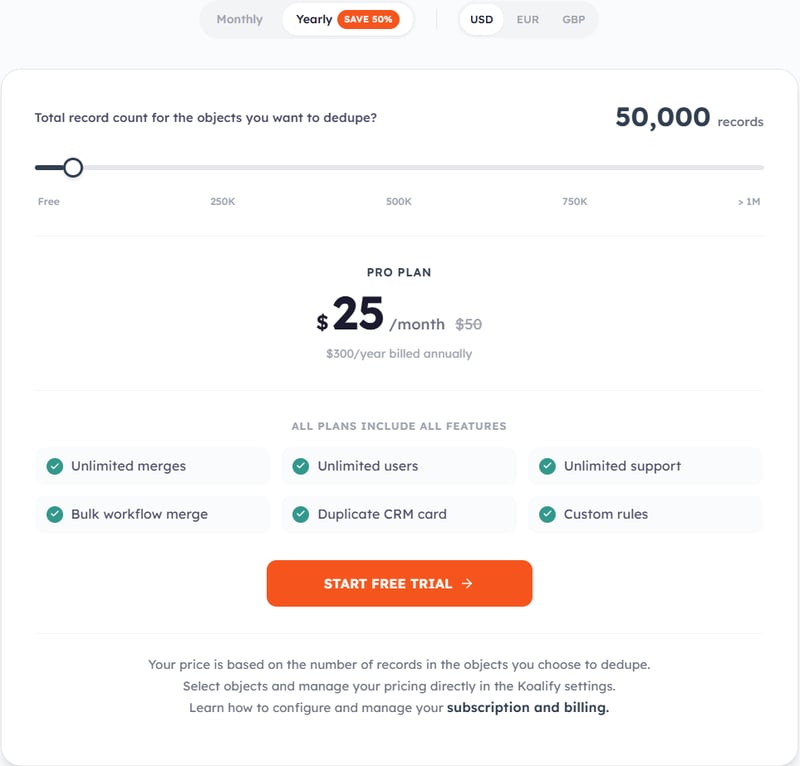
Pricing is based on the number of records for the objects you choose to deduplicate.
-
$5 per 10,000 records per month (billed annually)
-
$10 per 10,000 records per month (billed monthly)
-
Pricing is capped at $500/month for portals with over 1M records (billed annually)
-
-
Insycle:
-
Pricing is based on the total number of records in your HubSpot portal.
-
$10 per 10,000 records per month (billed annually)
-
$12.50 per 10,000 records per month (billed monthly).
-
Because Insycle offers additional data quality features beyond deduplication, overall platform cost may be higher.
-
-
Dedupely:
-
Pricing is tier-based and tied to the number of records in the selected objects.
-
~$9 per 10,000 records per month (billed annually)
-
~$11.70 per 10,000 records per month (billed monthly)
-
Tier-based pricing means that once record counts exceed a defined threshold, billing jumps to the next tier.
This can lead to higher effective costs compared to tools with linear or capped pricing models.
-
On annual plans, Koalify is typically ~50% more cost-efficient than other dedicated deduplication tools.
The pricing cap makes it especially attractive for larger HubSpot portals with hundreds of thousands or millions of records.
Pricing figures are indicative and based on publicly available information. Actual pricing may vary by contract, region, and feature set.
1. Security and Compliance
Why it matters
Mid-market and enterprise teams often require tools to pass internal security and procurement reviews. Certifications such as SOC 2 Type II and ISO 27001, along with GDPR compliance and data residency options, are often mandatory.
How tools differ
-
HubSpot meets these standards by default as the core CRM platform.
-
Koalify and Insycle both are SOC 2 Type II compliant
-
Koalify and Dedupely both are ISO27001 certified
- Koalify additionally supports EU/UK data residency
Security certifications confirm that standard security practices are implemented and whether a tool can be approved at all.
2. Native HubSpot Integration
Why it matters
This determines whether deduplication happens inside HubSpot or via an external interface.
Native solutions are generally easier for non-technical teams to operate and automate.
How tools differ
-
HubSpot’s native tools allow basic duplicate review and manual merging inside the CRM.
-
Koalify operates fully inside HubSpot, using properties, lists, and workflows
-
Insycle and Dedupely operate externally, requiring separate interfaces and processes
Teams that prioritize simplicity and operational consistency often favor native solutions, while data teams may be comfortable with external tools.
3. Object Coverage
Why it matters
Deduplication needs tend to expand as HubSpot usage matures. What starts with contacts often grows to include companies, deals, tickets, and custom objects.
How tools differ
-
HubSpot focuses mainly on contacts and companies
-
Koalify supports standard and custom objects, including tickets and deals.
-
Insycle supports the broadest range, including line items, and orders
-
Dedupely supports core objects but does not deduplicate tickets and cannot merge companies when Salesforce is integrated.
Broader object coverage reduces blind spots and prevents duplicate data from re-entering downstream workflows.
4. Control Over Matching Logic
Why it matters
Matching logic defines how duplicates are identified. Rigid rules miss real duplicates, overly loose rules create false positives.
How tools differ
-
HubSpot provides limited predefined rules
-
Koalify, Insycle, and Dedupely support flexible and fuzzy matching
In practice, matching rules typically identify ~90% of duplicates, fuzzy logic captures another ~5%, and a small remainder will often require manual review.
5. Control Over Merge Behaviour
Why it matters
Merge behaviour determines which record becomes primary and which field values are retained after a merge.
Poor control here can overwrite important data, break integrations.
How tools differ
-
HubSpot provides limited, predefined merge behaviour.
-
Koalify offers full control over primary record selection and field/property retention, making it well suited for automated merges.
-
Insycle also provides strong control but requires more manual setup in an external interface.
-
Dedupely offers basic merging with no control over primary selection and some property retention rules.
For teams relying on automation or external system syncs, merge control is often the most critical differentiator.
Tool profiles

1. Koalify: Best Overall Deduplication App for HubSpot
Koalify is a HubSpot-native deduplication tool built for teams that want to keep their CRM clean without leaving HubSpot or introducing a separate data tool. Instead of managing duplicates in an external interface, Koalify works directly with HubSpot properties, lists, and workflows.
Key characteristics
- Runs entirely inside HubSpot, using properties to flag duplicates, lists to review them, and workflows to merge records
- Supports ongoing, real-time deduplication, not just one-off cleanups
- Automated merges with control over primary record and field retention
- Enterprise-ready with SOC 2 Type II and ISO 27001 compliance
Trade-offs
- Designed specifically for HubSpot and does not support deduplication in other CRMs
Best for:
Koalify is strong for teams that want automation and control without complexity. Because it stays native to HubSpot, it’s easy for RevOps, Sales Ops, and Marketing Ops teams to manage without relying on a dedicated data specialist.

2. Insycle: Best for Broader Data Management
Insycle is a data operations platform that includes deduplication as part of a broader set of data quality tools. Rather than focusing only on duplicates, Insycle is designed for teams that need to manage many aspects of CRM data at once, including cleansing, normalization, associations, and bulk updates.
Key characteristics
- Additional tools for data cleansing, normalization, associations, and bulk changes
- Supports line items, and orders
- Highly customizable matching rules
Trade-offs
- Operates outside of HubSpot
- Requires more setup and ongoing maintenance
- Steeper learning curve for non-technical users
Best for:
Data teams or operations teams that are looking for more than deduplication, often working with large databases, complex data models, or multiple platforms.
When Insycle may not be ideal:
If your primary goal is lightweight, ongoing deduplication managed directly inside HubSpot by non-technical admins.
3. Dedupely: Alternative focused on deduplication only
Dedupely is a deduplication-focused tool that sits between HubSpot’s native features and a full data operations platform like Insycle.
In practice, Dedupely is most similar to Insycle as an external deduplication platform, but positioned as a lighter-weight and easier-to-use option. It focuses only on identifying and merging duplicate records, without the broader data cleansing, normalization, and association management capabilities that Insycle offers.
Key characteristics
- Easier to set up and use than full data operations platforms
- Responsive support team
- Suitable for teams that want to run simple bulk deduplication outside of HubSpot
Trade-offs
- No primary record control
- No property retention control
- No SOC 2 Type II
Best for:
Teams that want basic duplicate detection outside of HubSpot
Decision Checklist
Choose Koalify if:
-
You want deduplication entirely inside HubSpot
-
You need real-time automation across multiple objects
-
You require SOC 2 type II or EU/UK data residency
-
You want fine-grained merge control
Choose Insycle if:
-
You need more data quality features than only deduplication
-
You need to dedupe line items or orders
-
Your team is comfortable with complex external tools
Choose Dedupely if:
-
You need basic external deduplication
-
Advanced merge behaviour and ticket support are not required
Related HubSpot Deduplication Comparisons
If you’re evaluating specific tools in more detail, the comparisons below go deeper into detection logic, automation, merge behavior, and operational trade-offs:
-
Koalify vs HubSpot native deduplication – When built-in tools are enough and when automation and merge control become necessary
-
Koalify vs Insycle – HubSpot-native automation vs a broader external data operations platform
-
Koalify vs Dedupely – Native workflow-based deduplication vs lightweight external deduplication
These comparisons build on the criteria in this guide and help teams choose the right approach based on portal size, automation needs, and data complexity.